The crease is a hinge
When you fold paper firmly, you crush and realign fibres along a line. That line now bends far more easily than the flat panels on either side. In engineering terms you have made a living hinge: a flexible joint formed from the same material as the parts it connects. Every paper mechanism starts here.
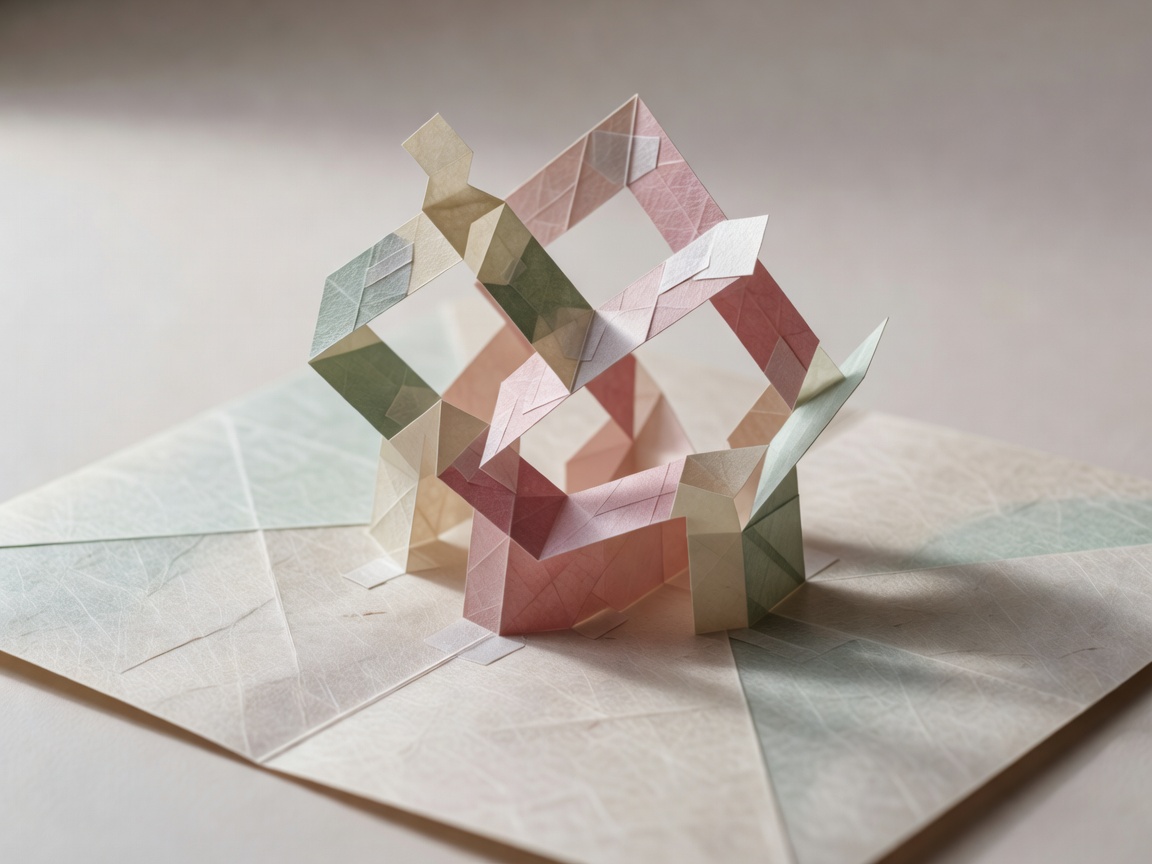
Once panels are joined by hinges, they behave like the rigid links of a machine. Push on one panel and the force travels across the creases to its neighbours. In a simple V-fold pop-up, opening a card pulls two anchor points apart; the folded piece glued between them has nowhere to go but upward. The page opening is the motor, the creases are the bearings, and the glue tabs are the fixed pivots.
- Card spine opens and pulls the anchors apart.
- Glue tabs transmit that pull to the V-piece.
- Central crease lifts out of the page.
- Full opening holds the shape flat and stable.
The Miura fold: one pull, many hinges
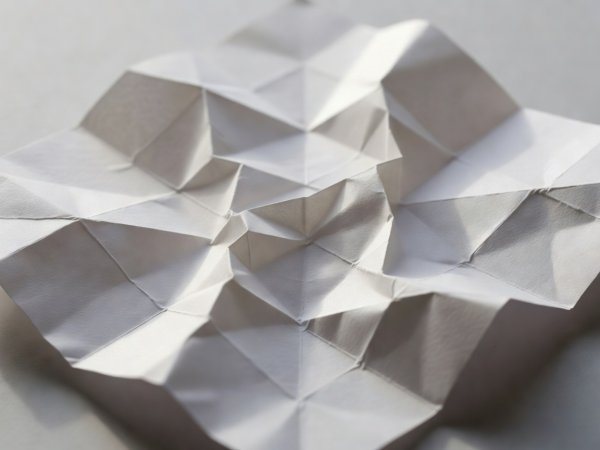
The Miura fold, developed by the Japanese astrophysicist Koryo Miura, covers a sheet with a grid of slightly skewed parallelograms. Because every crease is geometrically linked to every other, pulling two opposite corners opens the entire sheet in one smooth motion, and pushing them together collapses it again. The pattern was used for a deployable solar array on Japan’s Space Flyer Unit, launched in 1995.
For a maker, the Miura fold is a lesson in coupled motion. You are not folding many separate creases; you are operating a single mechanism with one degree of freedom. If one crease is placed carelessly, the whole sheet resists.
Bench tip: pre-crease every line in both directions before collapsing the pattern. The first collapse is the slowest; after a few cycles the sheet learns its path.
Fibre length is mechanical strength
Copy paper uses short wood-pulp fibres that crack after a few folds. Papers made from mulberry bark have long fibres that bridge the crease, so the hinge survives repeated use. Material choice is a design decision, not decoration.
Three paper traditions, three different aims
Japanese folding was recorded in print in Senbazuru Orikata of 1797, a book showing how to fold chains of cranes that remain joined at the wingtips from a single cut sheet. That connection is a structural problem: the shared paper must be wide enough to hold, narrow enough to allow each crane to fold. Japanese washi papermaking, particularly Hosokawa-shi, Sekishu-banshi and Honminoshi, was inscribed on UNESCO’s intangible heritage list in 2014.
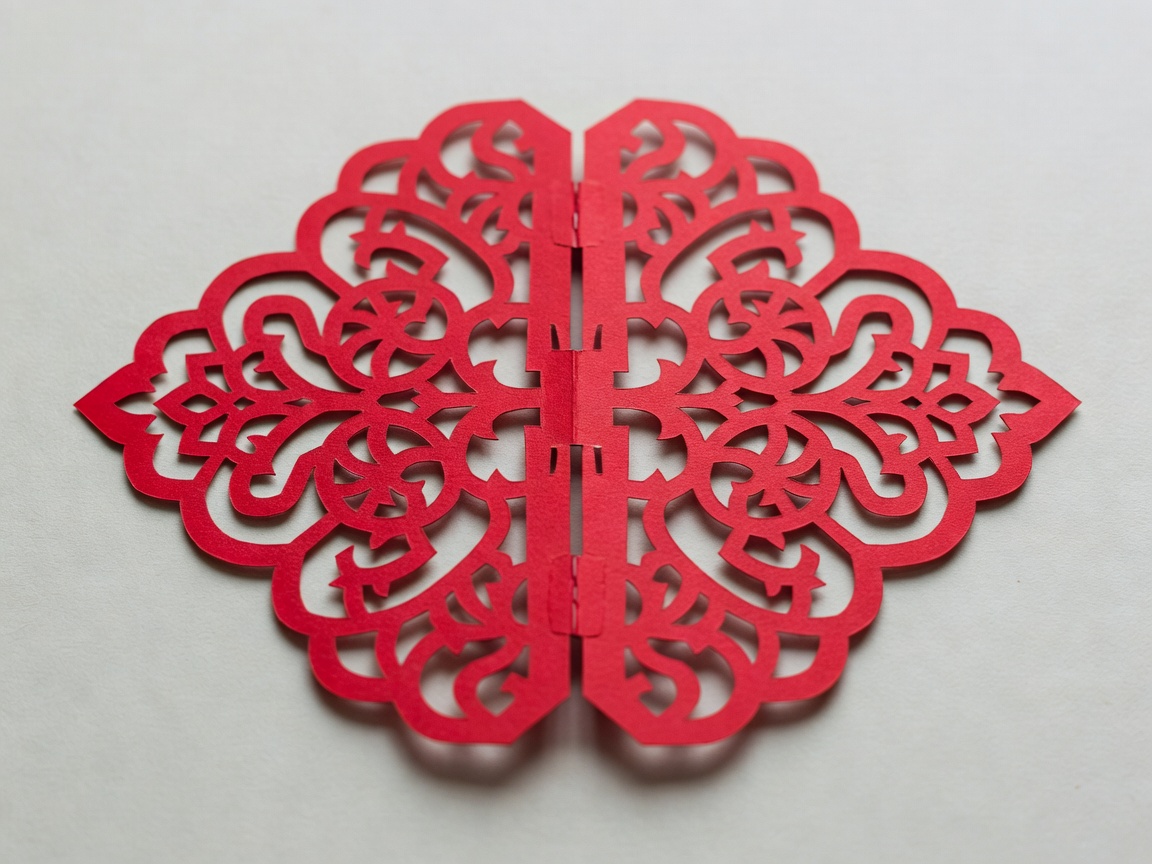
Chinese paper cutting, jianzhi, inscribed by UNESCO in 2009, folds paper before cutting so that a single cut produces symmetrical repeats. The fold here is a copying device rather than a hinge, but makers can borrow the method to cut identical linkage parts in one pass.
In Korea, hanji made from paper mulberry was durable enough to be twisted into cords and woven into vessels in the craft known as jiseung. That is paper used in tension, like rope.
Tradition
Joined cranes from Senbazuru Orikata share narrow paper bridges that act as flexible connectors.
Modern interpretation
Pull-tab cards use the same bridge idea: a narrow strip transmits motion from a tab to a moving figure.
Choosing paper for moving parts
- Kozo washi
- Long mulberry fibres; ideal for hinges that must flex many times.
- Hanji
- Korean mulberry paper; strong enough to twist and weave.
- Cardstock
- Stiff panels for pop-up links; score before folding to avoid cracking.
- Kraft paper
- Inexpensive and tough; good for prototypes.
A realistic first project is a two-panel pull-tab card: a sliding strip of cardstock, a washi hinge, and a figure that lifts when the tab is drawn. When that works, try a small Miura sheet, then compare its motion with the wooden joints that inspired many folding toys. For mechanisms that use paper alongside gears, see Miniature Builds.